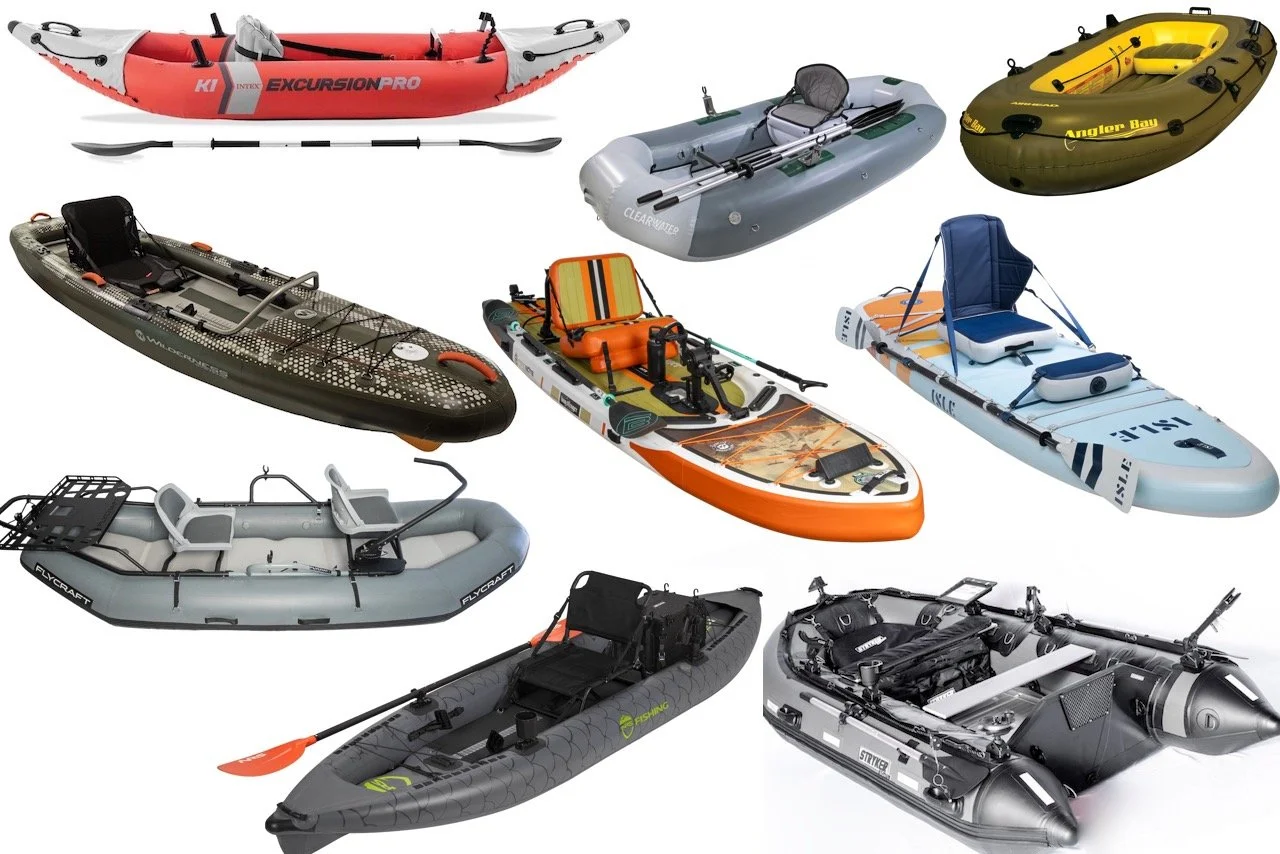
Nothing says freedom for an angler like having your own boat. You’ll have access to remote coastlines and deep-sea reefs, the ability to escape the crowds, and the freedom to head out, and stay out, on your own schedule.
There are dozens of boat types, each suited to different waters and species, and matching the boat to where you fish can make or break your day. Some deep-sea rigs cost hundreds of thousands of dollars and demand a marina berth or a heavy trailer. Others are simple, lightweight, and inexpensive—none more so than the inflatable boat. Don't mistake the low cost and portability for a lack of capability: inflatables are some of the most effective boats made, especially for rivers, lakes, inland waterways, back bays, and secluded flats.
Below is what to weigh when shopping for one, along with three standout models.
V-Hull vs. Catamaran
Inflatable fishing boats generally come in two hull styles: V-hull and catamaran. V-hulls have the classic dinghy feel and tend to handle longer cruises and distance better, but they're less stable underfoot for standing and casting. Catamarans, with their twin pontoons, offer a wider, more planted platform. Because of this design, anglers who like to stand while casting, especially fly fishers, tend to prefer them. If you're navigating choppier water or making longer runs, a V-hull is usually the better call. If a stable casting deck matters more, go with a catamaran.
Choosing the Right Size
Size comes down to how far you're traveling, how many people are fishing with you, and how much gear you're bringing. Solo anglers fishing calm water can get away with something as compact as 8 feet. Two anglers who like to travel light often find a 10-foot boat the sweet spot, as it offers enough room for a partner and moderate gear without adding much bulk. For bigger loads, longer days, or a fish finder and cooler setup, 12 feet gives you the most usable deck space.
Electric Outboard vs. Gas
Electric outboards are quieter, smoother, and don't burn gas, meaning less pollution in the water. They're also generally easier to maintain and store. Gas outboards, on the other hand, deliver more power for their size, support longer trips, and aren't limited by battery charge. As a rule, larger inflatables do better paired with gas, while smaller one-person boats on shorter outings suit electric well.
A third option is the trolling motor. It has a limited top speed, but it's a great fit for no-wake zones, small lakes, and ponds.
Rover Marine
Rover Marine builds a solid line of both hull styles: the Battle Boat (V-hull) and the Battle Cat (catamaran), each available in 8-, 10-, and 12-foot sizes. Both are made from durable PVC that resists punctures from ordinary hook contact, though anglers should still take care around hooks and other sharp tackle. The Battle Cat is the stronger pick for anglers who want to stand and cast, thanks to its wider stance and more stable deck, while the Battle Boat suits those who prefer a traditional dinghy feel for distance cruising. Both lines work well for inland freshwater fishing and hold up fine in protected inshore saltwater zones, though neither is built for open ocean conditions.
Sea Eagle 285fpb Frameless Pontoon
The ultimate solo rig, the 285fpb is a frameless 8-foot, 6-inch inflatable that's ready to fish in about 5 minutes total. Deflated, it measures 31 in x 20 in x 11 in, and packs easily into a car trunk. Its U-hull design offers stability, and with a draft of 4 inches, it makes fishing very shallow water possible. It comes equipped with two rod holders and four carry holders for portability; the Pro model comes with a pedestal swivel seat, though it is more expensive.
Stryker Pro 320 Inflatable Boat
A modern take on the classic inflatable motorboat, the 10.5-foot Stryker Pro 320 uses thermo-welded seams for durability, plus a 1.8mm shield wrap on the bottom for extra protection against abrasion. Its transom accommodates an outboard engine, and its 1,520-pound capacity supports trips for up to five people with gear. Five built-in rod holders around the interior give you plenty of places to anchor gear, and its sturdy construction handles both calm and rough water reasonably well, making it a solid option for saltwater outings. All of that capability comes at a price, though—this is one of the pricier inflatable boats on the market. The Stryker website in mid-2026 had the price at more than $4,000.
The Bottom Line
An inflatable won't replace a full-size center console for offshore work, but for rivers, lakes, and protected coastal waters, it's hard to beat for cost, storage, and genuine fishing capability. Match the hull and size to how you actually fish, and you'll spend a lot more time on the water for a lot less money.