The Best Safety Gear for Fishing Boats
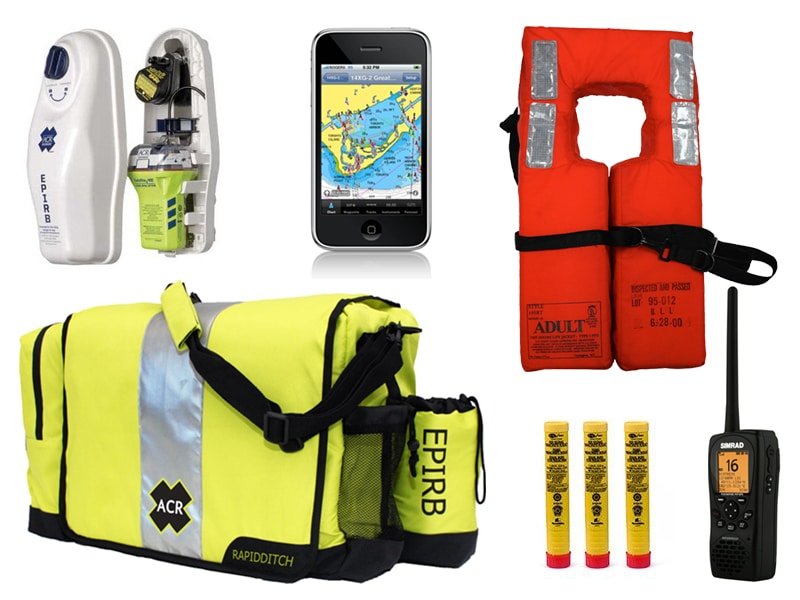
For an ocean-loving angler, it doesn’t get much better than a day out on a boat—drifting listlessly at sea with a line in the water or chasing a school of potential trophies on a fish finder. Obtaining a fishing boat has long been the holy grail for dedicated anglers, whether it’s a fully outfitted, luxury deep-sea yacht or a small skiff for exploring one’s favorite local backwater haunt. But embarking on a boat trip isn’t just exciting—it is also dangerous. From leaking hulls and fires to stalled engines and unexpected storms, being out on the water comes with its fair share of risks.
After all, it doesn’t matter how well you can swim if you are stuck far offshore in the middle of the night with bad visibility, a leaking boat, and the Gulf Stream ready to rush you up the coast and out to sea.
The risks involved in boating are precisely why it is so important to ensure that all watercraft are equipped with all of the mandatory safety equipment, along with a number of extras that can mean the difference between making it home safely or not. The following list of equipment should be considered essential purchases, whether the Coast Guard requires them or not.
Life Jacket/Personal Flotation Device
It should go without saying that every boat should have a Coast Guard-approved life jacket or personal flotation device for every passenger on board. This is required by the Coast Guard, and is perhaps the single most effective way to prevent drownings in the case of a boat accident or sinking.
First-Aid Kit
First-aid kits are small and compact, and they can make a huge difference if someone gets hurt in an accident or collision. A comprehensive first-aid kit might include bandages, a stitch kit, antiseptic, gauze, burn supplies, sting supplies, an EpiPen, and sea sickness medication.
Extra Water and Food
One of the simplest ways to prepare for unexpected emergencies—or even just inconvenient delays—is to pack extra food and water. Since most people heading out for a day on a boat will already be packing a lunch and beverages, it takes very little extra effort to pack twice as much, but it can make a world of difference.
Communication Equipment
Mobile phones might seem like a sufficient option for communication during boat trips, but they can fail in a number of ways, such as if they get wet, run out of batteries, or lose service. A VHF radio is the industry standard for communication at sea—and having a second backup VHF radio is an even better policy.
Emergency Location Tools
Many anglers will have GPS-powered electronics (such as fish finders and Garmin) on their boats for navigation purposes, but it’s a good idea to go one step further with satellite-linked emergency location tools. An emergency position indicator radio beacon (EPIRB) is intended to be attached to a boat or other watercraft, and provides a detailed location to facilitate rescues. EPIRBs can be manually activated, but can also be programmed to automatically activate if they come free of a boat. Personal location beacons (PLBs) provide another level of protection, as each passenger carries one on their person in case they are separated from the boat.
Extra Parts and Tools
It is always a good idea to have a handful of spare parts and tools on board, in case something on the boat breaks. A replacement kill switch (cut-off lanyard); a one-time replacement flywheel pull rope; basic tools such as wrenches, screwdrivers, and spark plug sockets (plus extra spark plugs); and a handful of replacement screws, nuts, and bolts can facilitate quick fixes. Duct tape and WD-40 are also helpful. Of course, none of these supplies are of any use unless someone has repair skills, so it’s a good idea to take a basic boat repair course, as well.
Signaling Equipment
The Coast Guard requires all boats to have signaling equipment, including flares and some sort of sound signaling device (typically bells or whistles). A mirror can also be useful for signaling planes and distant boats during the day, while a loud horn can be useful at night.
Fire Extinguisher
The Coast Guard also requires fire extinguishers on all boats—and even if they don’t, it would be unwise to leave the dock on a motorized vessel without some way of putting out a fire. Check official regulations to see the number of fire extinguishers required for each size of vessel.
Bilge Pump
A bilge pump (or, alternatively, a bailer or bucket) is essential if a boat springs a leak or takes on water from rain or large waves. Not only does it make boating safer, but it also makes time spent on a boat more comfortable.
Navigation Lights
Navigation lights are a mandatory safety feature on all boats. They must be of the proper color, strength, and location, and are required to be illuminated while traveling at night. Boaters must also understand the meaning of the various lights and know how to navigate past other vessels safely.