5 of the Top Advancements in Fishing
Humans have been fishing for survival for tens of thousands of years and were likely catching fish with their bare hands hundreds of thousands of years before then. Isotopic analysis of the skeletal remains of a Tianyuan man from 40,000 years ago indicate that he regularly ate freshwater fish, and archeological finds from that time period include fish bones, shell middens, and paintings of sea food harvesting. The technique of angling likely came into use around 15,000 to 30,000 years ago, with hand-carved bone and shell hooks dating back to that era having been discovered in Japan and East Timor, respectively. Meanwhile, Egyptians regularly fished the Nile with nets, spears, and basic fishing rods between 4,000 and 10,000 years ago.
It is impossible to know when exactly angling became a recreational pursuit rather than simply one geared toward survival, but the Romans, Chinese, and Egyptians were all believed to have fished for leisure by the 15th century. Long before then, fly fishing was documented in Japan in the ninth century BCE, and in Macedonia in the second century CE. The first recreational fishing guide was published in England in 1496 (titled Treatyse of Fysshynge wyth an Angle), and by the 17th century, angling was extremely popular throughout the UK. The next 200 years saw the sport explode around the world, as advancements in reels, rods, and lines facilitated by the Industrial Revolution made fishing accessible and affordable to the masses. Finally, technological advancements in the 20th century (such as synthetic line and fiberglass poles) helped usher in an age of greater efficiency in the pursuit of fish for sport, laying the foundation for what is today a worldwide pursuit with dozens of different styles and manifestations.
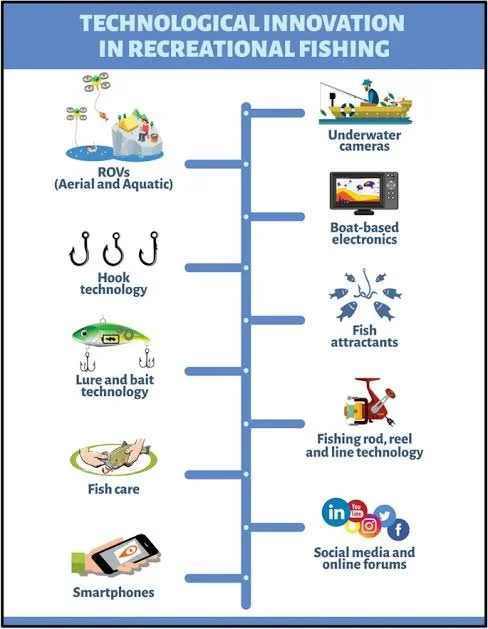
For a time, it seemed as if this timeless activity had evolved as far as was possible. However, the last decade has seen a quantum leap in fishing-related technology, ranging from better boats equipped with forward-facing sonar to braided line, advanced knots, and smart reels. The following are some of the advancements that are currently reshaping modern angling.
1. Forward-Facing Sonar
Perhaps nothing has changed modern sport fishing as much as forward-facing sonar. Unlike older fish finders, which gave a hindcast of what had previously swam under a boat, forward-facing sonar provides real-time images of schools and individual fish that are so detailed it’s now possible to identify species and size, and intentionally target specific trophy fish. Anglers can repeatedly cast directly onto a single fish, adjusting technique based on real-time analysis of its reaction and behavior. While there are those who feel this technology is killing the soul of fishing, it has arguably advanced competitive fishing faster than any previous technological evolution.
2. High-Tech Boats
Today’s high-tech boats are equipped with a number of features that would have been unthinkable a decade ago—and that are making the pursuit of big game fish not only more efficient, but also more comfortable. Carbon fiber hulls mean stronger, lighter, faster boats, while gyrostabilizers reduce roll and make the journey more enjoyable. Meanwhile, GPS-enabled trolling motors can effectively “anchor” a boat over a school of fish (located with forward-facing sonar, of course) and keep it in place all afternoon, regardless of currents, surface sea state, or the movement of the fish.
3. Carbon and Graphite Fiber Rods
While fiberglass was a huge breakthrough when it came to producing cheaper, stronger, lighter rods, higher modulus carbon fiber and graphite fiber rods have taken things to the next level. High-quality rods now weigh as little as 4 ounces, making them easier to transport and handle, without sacrificing strength, performance, or sensitivity.
4. Smart Fishing Technology
To complement high-tech rods, a variety of smart fishing devices have ushered the angling experience into the 21st century and beyond. Predictive AI helps to identify ideal conditions, wearable trackers compile data about fishing style and ability for analysis by AI coaches, and app-powered smart tackle takes casting to the next level. Meanwhile, bio-engineered lures, braided line, and even simple advancements like the FG knot mean more effective fishing in both saltwater and freshwater.
5. Sun-Protective Fishing Clothing
While few people think of clothing as a marvel of modern fishing technology, the reality is that the lightweight, breathable, moisture-wicking, UPF sun shirts, hats, neck gaiters, and even leggings that have popped up on the market over the past few years are making angling safer, more comfortable, and infinitely more enjoyable. When an angler can comfortably remain on the water all day long, it not only increases their odds of landing the big one, but also ups their fun meter considerably. After all, fishing is what fishers love to do, so the longer they can do it, the better. The fact that much of this sun-protective clothing is now being made in an environmentally sustainable manner is an added bonus, as it means less degradation of the very bodies of water that anglers are jigging and trolling.